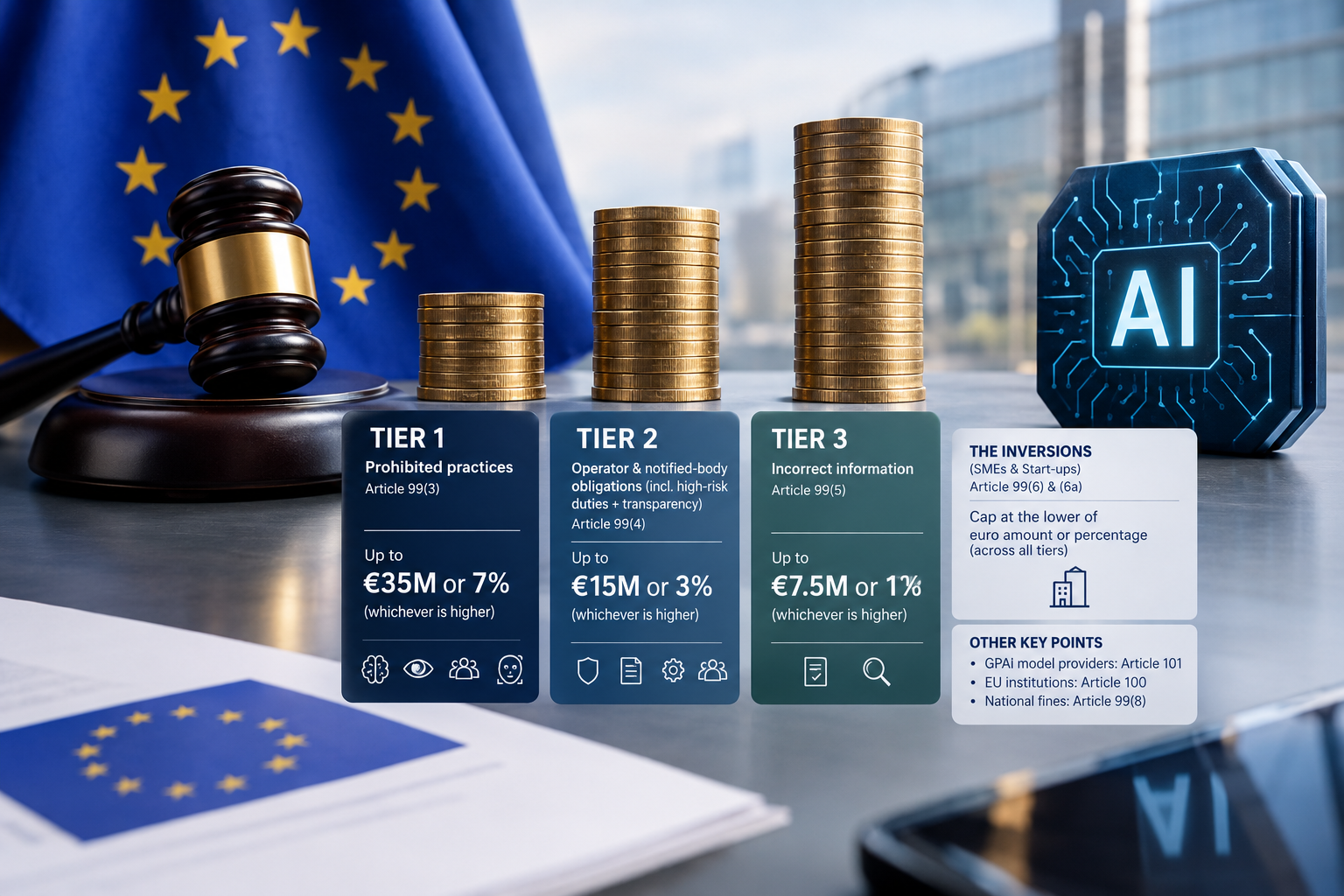
€35 million. Or 7% of global turnover. Whichever is higher. Here is the penalty structure in full — and the parts most summaries get wrong.

Image AI-generated. All text human-written.
The EU AI Act backs its rules with one of the most significant fine regimes in EU law — its ceilings exceed the GDPR’s €20 million / 4% — and with a structure that is misquoted daily. Every tier runs on two limbs: a fixed euro maximum and a percentage of total worldwide annual turnover, and the applicable ceiling is whichever is higher. For a €2 million startup, the euro figure binds; for a €1 billion company facing the top tier, the ceiling is not €35 million — it is €70 million. Ceilings, not verdicts: real fines are set by discretion, against listed factors. But ceilings are what boards insure against, and these were designed to scale with size so that non-compliance never becomes a manageable cost of doing business.
Tier 1 — prohibited practices · Article 99(3) · up to €35M or 7%
The top tier belongs to Article 5 alone — the prohibited practices: subliminal manipulation, exploitation of vulnerabilities due to age, disability or social and economic situation, social scoring, predictive criminal profiling based solely on personality, untargeted facial-image scraping, emotion recognition in workplaces and education, biometric categorisation of sensitive traits, and real-time remote biometric identification for law enforcement outside narrow exceptions. These have applied since 2 February 2025, and two further prohibitions — targeting non-consensual intimate imagery and child sexual abuse material — join them on 2 December 2026. A company running a prohibited system today has a current violation, not a future risk. And the €35M/7% figure belongs to this tier only: quoting it for anything else in the Act is the single most common penalty error in circulation.
Tier 2 — the Article 99(4) list · up to €15M or 3%
Routinely mislabelled “the high-risk tier” — and the mislabel matters. Article 99(4) attaches its ceiling to a list of operator and notified-body obligations that includes the high-risk duties (risk management, documentation, data governance, oversight, conformity assessment) and the Article 50 transparency obligations for providers and deployers — point (g) of the list. The consequence: a company with nothing high-risk at all can sit in this tier, and part of it is live today. The transparency duties have been enforceable since 2 August 2026; the high-risk obligations the same tier covers arrive on 2 December 2027 for stand-alone Annex III systems and 2 August 2028 for AI in regulated products, under Article 113 as amended. One tier, two clocks. The list also reaches deployers, importers, distributors and authorised representatives — every role in the chain carries obligations, and every role is exposed when they fail.
Providers of general-purpose AI models face the same €15M/3% ceiling under a separate regime — Article 101 — for failures against their model-level obligations. Note the noun: model providers, fined directly by the Commission.
Tier 3 — incorrect information · Article 99(5) · up to €7.5M or 1%
The tier for supplying incorrect, incomplete or misleading information to notified bodies or national competent authorities — the provision that catches false declarations and evasive answers to information requests. The smaller ceiling is not a smaller problem: a public finding that an organisation misled its regulator does damage no fine figure captures.
The inversions — and the tier nobody lists
Article 99(6) flips the rule for SMEs and start-ups: each fine is capped at the euro amount or the percentage, whichever is lower — across all three tiers. Article 99(6a) extends the same inversion to small mid-cap enterprises. A €5 million-turnover SME facing the top tier is therefore capped at €350,000, not €35 million: calibrated, not eliminated. Two further edges complete the full picture: fines on EU institutions themselves are handled separately — the European Data Protection Supervisor fines Union bodies under Article 100, at far lower ceilings — and how far national administrative fines can reach public authorities is left by Article 99(8) to each Member State.
Who enforces, and what else they can do
Enforcement of Article 99 is decentralised: each Member State’s market surveillance authority investigates and fines within its jurisdiction — there is no single EU body issuing these fines, and practice will vary by country. Article 101 is the exception: GPAI model providers face the Commission’s AI Office directly. And fines are the slow instrument. Authorities can order corrective action, withdrawal, recall, or restriction of a system — and for a company whose product is the system, a suspension order is a business interruption that dwarfs most fines. Enforcement outcomes will be visible, and the reputational cost prices itself.
The honest context — how fines are actually set
Every figure above is a ceiling. Article 99(7) lists what regulators must weigh: the nature, gravity and duration of the infringement, the number of people affected and the damage done, prior fines, the operator’s size and market share, cooperation with authorities — and, in point (i), the intentional or negligent character of the infringement. That last factor deserves more attention than it gets: the same breach reads very differently when the file shows a process gap versus a deliberate choice, and evidence of intent is exactly what procurement records and tool logs provide. A first infringement, promptly remediated, cooperatively handled, will not meet a maximum. A knowing one, at scale, stonewalled — that is what the ceilings exist for.
The calculus this structure creates is deliberate: with percentage-of-turnover ceilings and an enforcement network now in place, the probability of enforcement does not need to be high for the expected cost of non-compliance to exceed the cost of a well-built record. Which obligations — and which tier — actually attach to your systems starts with classification, traced to the text. ExecLevel AI builds that record in weeks.
Map your systems to their tiers — a free assessment conversation at www.execlevelai.eu
Disclaimer: This article is for general informational purposes only and does not constitute legal or compliance advice. EU AI Act requirements may vary depending on your organisation, AI system, and use case. For advice on EU AI Act compliance, visit www.exclevelai.eu