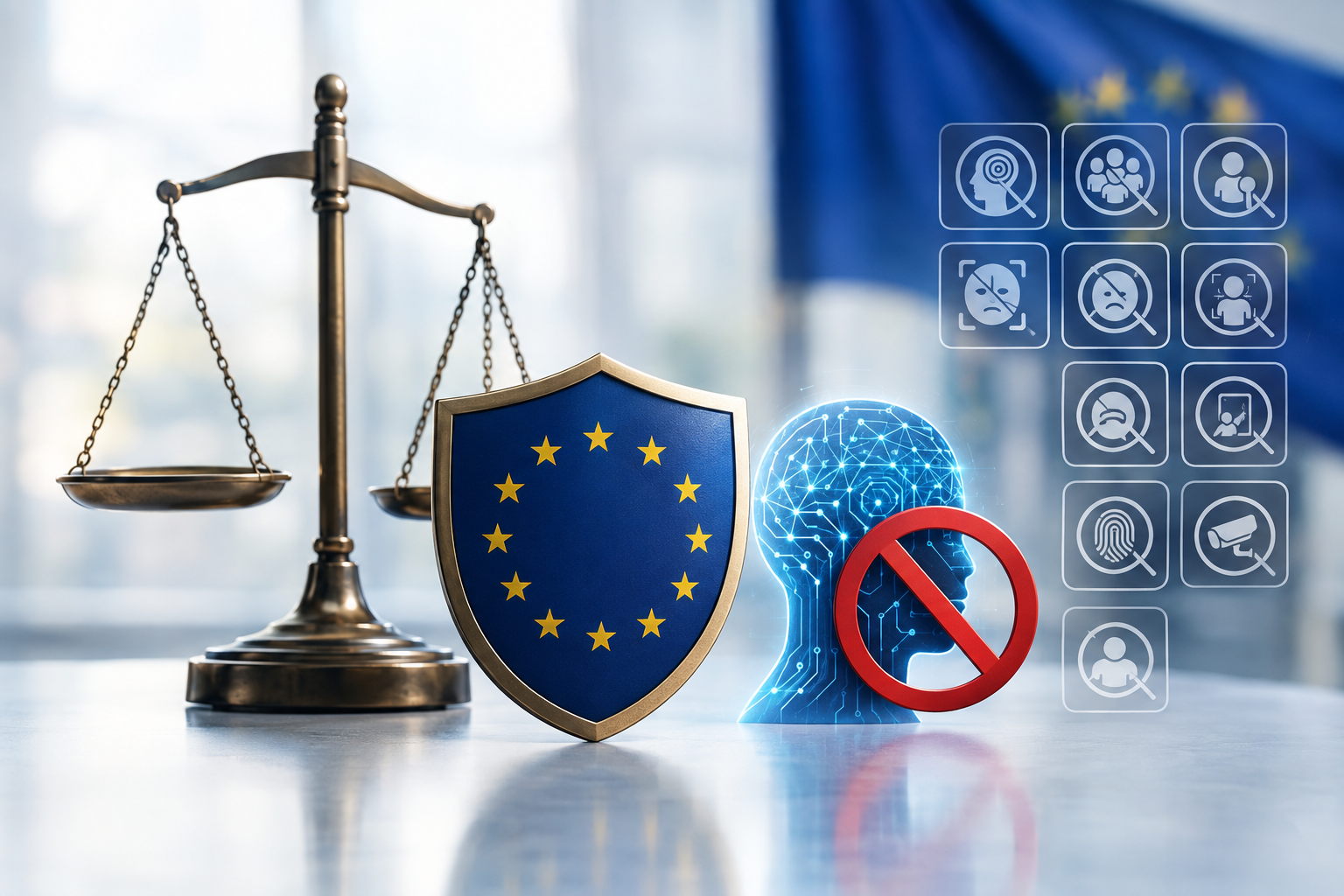
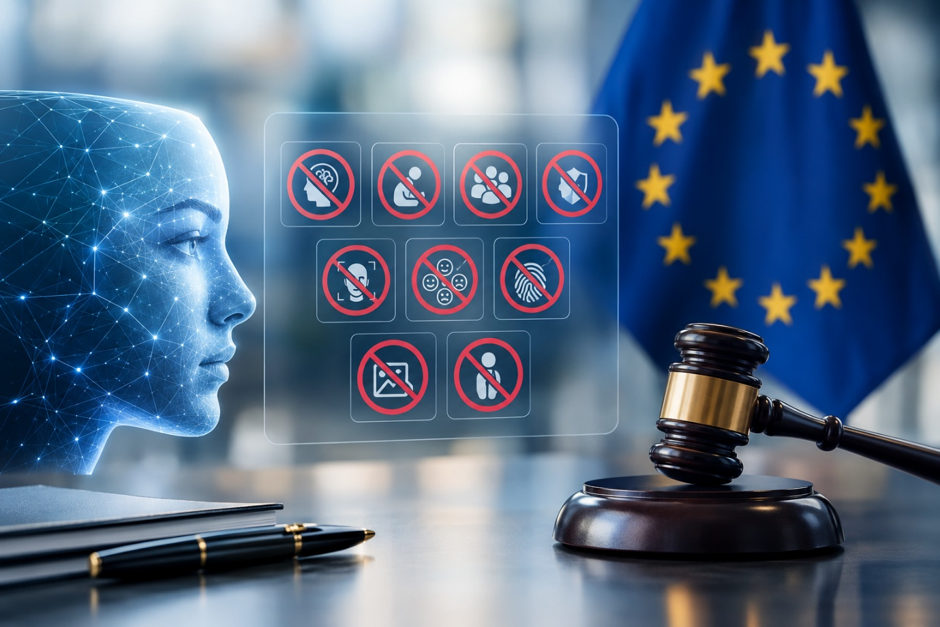
Image AI-generated. All text human-written.
Most EU AI Act attention goes to the deferred high-risk regime and its 2027–2028 deadlines. Article 5 does not care about that conversation. Its prohibitions became applicable on 2 February 2025 — the first provisions of the entire Regulation to bite, because the EU judged these practices too incompatible with fundamental rights to wait. They are absolute: no consent framework, commercial justification or clever classification crosses them. They bind providers and deployers equally, reach non-EU companies serving the EU, and carry the Regulation’s highest penalty tier — up to €35 million or 7% of worldwide annual turnover, whichever is higher. Eight prohibitions are live today. From 2 December 2026, the amending Regulation adds two more. Every AI company should know all ten.
The eight in force now
1 — Subliminal manipulation — Article 5(1)(a). AI deploying techniques below conscious awareness that materially distort behaviour, causing or likely to cause significant harm. All three elements must be present. The Commission’s February 2025 guidelines confirm transparent, preference-based advertising is not inherently manipulative; AI engineered to bypass conscious decision-making — dark patterns blocking cancellation, compulsion-engineered engagement loops — is what this describes.
2 — Exploitation of vulnerabilities — Article 5(1)(b). AI exploiting vulnerabilities due to age, disability, or social or economic situation, with the objective or the effect of materially distorting behaviour toward significant harm. No subliminal technique required — and no intent required. Targeting detected financial distress with high-interest products sits here; identifying vulnerability to improve accessibility does not. The line is what the identification is for.
3 — Social scoring — Article 5(1)(c). Evaluating or classifying people based on social behaviour or inferred characteristics, producing detrimental treatment that is unjustified in context or disproportionate. Aimed at generalised citizen-scoring of the kind that aggregates behaviour across unrelated contexts into one consequence-bearing score.
4 — Predictive criminal profiling — Article 5(1)(d). Risk-assessing whether a person will commit an offence based solely on profiling or personality traits. The qualifier is “solely”: AI surfacing documented, evidence-based leads for human investigators is outside; scoring criminality from demographics or inferred character, without documented conduct, is inside.
5 — Untargeted facial-image scraping — Article 5(1)(e). Creating or expanding facial recognition databases by untargeted scraping of the internet or CCTV. The prohibition attaches to the collection method itself — harvesting faces at scale — regardless of how the database is later used.
6 — Emotion recognition at work and in education — Article 5(1)(f). Inferring emotions in workplaces or educational institutions, except for medical or safety reasons. The most commercially relevant prohibition on the list: interview engagement-scoring, employee sentiment monitoring from face or voice, student emotion tracking. The exception is narrow — fatigue detection for safety-critical roles fits; general workforce mood monitoring does not.
7 — Biometric categorisation of sensitive traits — Article 5(1)(g). Using biometric data to deduce race, political opinions, trade union membership, religious or philosophical beliefs, or sexual orientation. Identity verification is not what this targets; deriving protected characteristics from faces or voices is.
8 — Real-time remote biometric identification for law enforcement — Article 5(1)(h). In publicly accessible spaces, prohibited subject to three narrow exceptions — targeted victim searches, specific imminent threats, and serious-offence suspects — each wrapped in demanding procedural conditions including prior authorisation.
The two arriving on 2 December 2026
The amending Regulation — Regulation (EU) 2026/1744 — adds prohibitions targeting AI that generates non-consensual intimate imagery and child sexual abuse material, including circumventing a system’s safeguards to produce it. For providers of generative tools, safeguard robustness stops being a trust-and-safety virtue on that date and becomes a line in the statute. Deep-dive pieces written before the amendment count eight prohibitions; from December, the accurate count is ten.
The enforcement reality, stated honestly
The prohibitions have applied since February 2025; the penalty provisions attached from August 2025; and the national market surveillance machinery — the authorities who investigate and fine — acquired their powers on 2 August 2026. As of this article’s verification date, no public Article 5 enforcement action has been announced. That is a fact worth stating plainly — and worth reading carefully: the GDPR’s first years were similarly quiet before they were not, and the network now enforcing this Regulation is built on the same national authorities that spent seven years learning how. Absence of announced fines is not absence of risk. It is the quiet period in which the first examples get chosen.
The Grey Zone
Article 5 is deliberately narrow — the EU prohibited what it considers incompatible with dignity and rights, not AI in general. But narrow is not the same as clear. Emotion recognition outside work and education is not prohibited — it can be high-risk under Annex III instead, and it carries its own transparency duty. Biometric categorisation for other purposes needs analysis of what the outputs actually derive. Private-sector scoring escapes Article 5 but not necessarily the GDPR or consumer law. If a system operates near any of the ten lines — not clearly across, but near — the governing question is not whether the team is comfortable with the use case. It is whether a market surveillance authority reviewing it would agree, and whether a written, dated analysis exists showing the question was asked before anyone official asked it.
Whether a system is prohibited, high-risk, transparency-tier or out of scope starts with the same step: classification, traced to the text. ExecLevel AI builds that record, system by system, in weeks.
Find out where your systems sit against all ten lines — a free assessment conversation at www.execlevelai.eu
Disclaimer: This article is for general informational purposes only and does not constitute legal or compliance advice. EU AI Act requirements may vary depending on your organisation, AI system, and use case. For advice on EU AI Act compliance, visit www.exclevelai.eu